


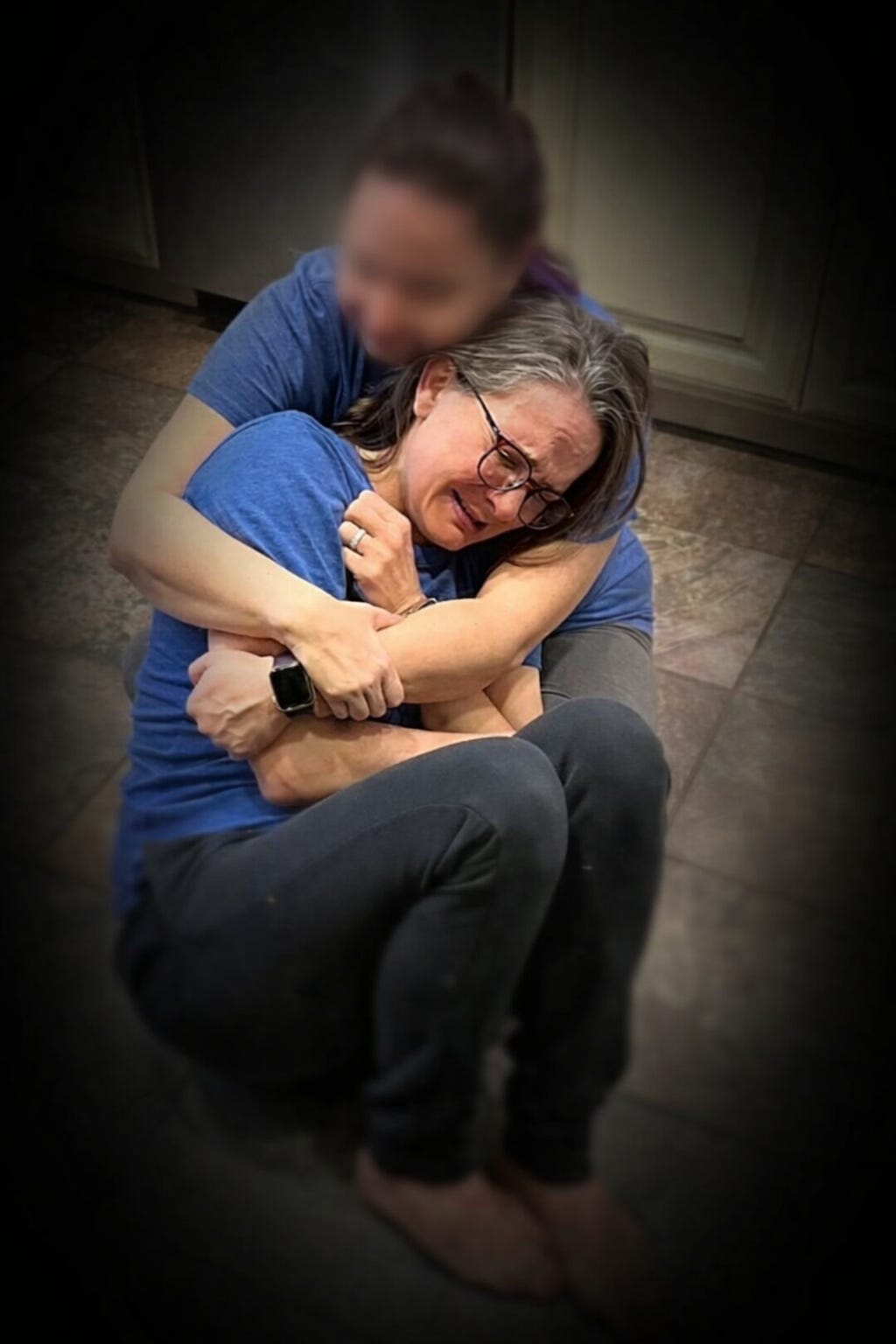
If you’re new here, the truest way to meet me isn’t through a polished headshot. It’s through a picture of me on the kitchen floor—bare feet on tile, face crumpled in grief, folded into myself while a friend wraps her arms around me and refuses to let go.
That photo holds more of my story than any smile ever could.
The tile was cold. My body was shaking. I’d had some wine that night, and the mask I’d worn for years finally slipped. Decades of stuffed-down anger, grief, and confusion came pouring out in waves I couldn’t control or stop. My body finally did what it had needed to do for years: it collapsed.
And this time, someone stayed.
She didn’t quote a verse at me. Didn’t tell me to calm down or pray harder. She just held me while I fell apart.
For years I tried to be the strong one. The spiritual one. The “I can handle it” one. I loved Jesus, I served in church, I knew the Bible—but my nervous system was wrecked from long-term emotional, spiritual, and relational trauma.
I kept hearing: “If you really trusted God, you’d be calmer. If you had more faith, you wouldn’t be this anxious.”
Inside I thought: Then why am I falling apart when I love Him so much?
What I didn’t know then was that I’d spent years in an emotionally and spiritually abusive marriage—gaslighting, control, constant blame. I’d been misdiagnosed as bipolar when what I actually had was trauma. A psychiatrist finally said the words that changed everything: “You’re not bipolar. You’re in an abusive relationship.”
I’d asked churches for help and been met with quick prayers, dismissal, or even expulsion. I was living with sensory sensitivities and a nervous system that picked up more than most people saw. All of it left me feeling like I was “too much.”
This was not the first or last time I ended up on the floor —a couple of times was with my husband. Decades of pain spilled out, some of it his, much of it not. He could have walked away. He could have defended himself or shut me down.
Instead, he stayed.
He let me empty the bucket. When I finally hit the floor sobbing, I kept saying, “I’m so sorry. You didn’t deserve that.”
He gently owned the part that was his, and simply let the rest be. We grew closer on the other side of that awful, holy mess.
Those moments on the kitchen floor reframed everything for me.
I grew up thinking discipline meant punishment and discipleship meant “behave better.” But when I finally looked at what those words actually mean in the New Testament, I cried.
Discipline—the Greek word paideia—doesn’t primarily mean punishment. It means training, nurturing, being formed. It’s what a loving parent does to help a child grow.
Disciple—mathetes—means learner, a student shaped by the teacher’s way of life, not just their rules.
And then there’s Hebrews 5:8, which says Jesus “learned obedience through what He suffered.” Jesus didn’t just hand out commands from a distance. He stepped into a human body, with a human nervous system, and felt the weight of obedience from the inside.
Gethsemane—sweating drops of blood, crying out for another way, surrendering anyway.
So when I’m shaking, nauseous, or curled up on the floor, it doesn’t mean I’m failing spiritually. It might mean I’m sitting in the same classroom where Jesus Himself learned obedience.
Now, discipline sounds like, “I love you too much to leave you stuck. Let’s grow through this together.”
And discipleship looks like someone staying in the room while I learn—holding space, naming truth, pointing me back to Jesus when it gets messy.
Two threads run through almost everything I write: Scripture and trauma.
I dig into Greek and Hebrew not to win arguments but to find the God who is better than what my pain taught me. And I study trauma because I need to understand why “crazy-making” relationships distort reality, how abuse and grief shape the nervous system, and why so many people are misdiagnosed when what they’re actually living with is prolonged trauma.
For years, most of my real help came from trauma-informed counselors and other survivors, not church spaces. Too often, church gave me clichés, blame, or silence. That mix—deep love for Jesus, deep hurt from His people, and deep curiosity about how He designed us—is what fuels everything I write.
I believe the good news of Jesus is good news for our nervous systems, our trauma histories, and our complicated relationships—not just our afterlife.
I believe the Body of Christ can be a safe place to fall apart if we learn how to stay present with people without trying to fix them. Not because we celebrate staying broken, but because that’s how Jesus did it. He not only modeled the power of presence—He died so His Presence could be with all of us at the same time. And now, though His physical body isn’t here the way it once was, He loves through our surrendered lives.
I believe the church needs trauma-informed, Spirit-led discipleship—leaders and congregations who notice the one shaking or crying in the back row.
I can’t fix all of that. I’m still in process myself. But I can tell the truth, invite Scripture into my mess, bring what I’m learning from trauma recovery, and build small pockets of safety where we wrestle with Jesus together.
This space is where I process my journey out loud—messy honesty, Greek and Hebrew word studies, stories with pictures, truth and tenderness without sugarcoating or shaming—praying it helps others on their journey toward healing with Jesus.
If any of this sounds familiar, if you’ve been told you’re too much or too broken or too anxious to really love Jesus, this is for you.
You’re welcome to read quietly, respond, wrestle, or question.
I’m glad you’re here.